Measure First: U.S. Gutter Installation Cost and 3 Home Budgets
Most homeowners pay between $6 and $15 per linear foot for professionally installed seamless aluminum gutters, with a typical whole-home project landing between $1,000 and $5,000, most often near $2,500 to $3,000. Your final number shifts based on material choice, roof pitch, home height, and how much old gutter has to come down first.
TL;DR:
- Material choice significantly impacts costs, with vinyl being the cheapest and copper the most expensive, affecting the total by up to several thousand dollars.
- Larger or more complex homes with steep roofs and multiple stories require higher bids due to increased labor, materials, and safety equipment.
- Accurate measurement of roofline, corners, and downspouts helps avoid overpaying and ensures a precise estimate from contractors.
- Add-ons like gutter guards, oversized downspouts, and fascia repairs can increase total costs by hundreds of dollars, but proper maintenance reduces long-term expenses.
- Regional factors such as labor rates and climate conditions influence prices, with high-cost metros and harsh climates generally leading to higher installation bids.
Table of Contents
- How Much Does Gutter Installation Cost? A Quick Breakdown
- Which Gutter Material Costs the Most (and Least)?
- Why Do Gutter Quotes Vary So Much Between Contractors?
- How Do You Measure Your Roofline for a Gutter Estimate?
- What Add-Ons and Maintenance Costs Should You Budget For?
- How to Get Accurate Quotes and Compare Bids
- Real Budget Examples: Small, Medium, and Large Projects
- How Long Does Gutter Installation Actually Take?
- Do Gutter Prices Vary by Region or Climate?
- What This Guide Gets Right That Most Estimators Miss
- Get Matched With Local Gutter Installers Through Pnvleads
- Sources
- FAQ
How Much Does Gutter Installation Cost? A Quick Breakdown
The national midpoint for gutter work sits close to $2,500 to $3,000 for a full installation on an average home, though smaller homes with simple rooflines can come in under $1,000 and large or architecturally complex houses can push past $5,000. That range holds up across most industry cost guides, which consistently list seamless aluminum gutters in the $6 to $15 per linear foot bracket once labor is factored in.
Quotes usually break down into three buckets, and understanding that split helps you spot a lowball bid or a padded one before you sign anything.
- Materials: The gutter sections, hangers, end caps, elbows, and sealant, typically 30 to 45 percent of the total.
- Labor: Measuring, cutting (for seamless systems, this happens on-site with a portable machine), hanging, and sealing joints, usually 40 to 60 percent of the bill.
- Extras: Downspout upgrades, gutter guards, disposal of old material, and any fascia repair uncovered during teardown.
Here’s how that plays out by home size:
- Small home (under 1,500 sq ft, roughly 100 to 120 linear feet): $700 to $1,600
- Medium home (1,500 to 2,500 sq ft, roughly 150 to 200 linear feet): $1,200 to $3,000
- Large home (2,500+ sq ft, 200+ linear feet, multiple stories or dormers): $2,500 to $6,000+
A contractor quoting a flat number without breaking out these pieces is giving you a guess, not an estimate. Ask for the linear footage they measured and the per-foot rate they used. If they can’t produce both, get a second bid.
Which Gutter Material Costs the Most (and Least)?
Material choice swings your total more than almost any other single decision, and the gap between the cheapest and most expensive option is bigger than most homeowners expect.
Vinyl is the budget option, running roughly $3 to $6 per linear foot installed. It’s lightweight, resists corrosion, and is easy for a handy homeowner to install as a DIY project. The tradeoff: it becomes brittle in extreme cold and can sag under heavy snow loads, so it’s a weaker fit for northern climates with harsh winters.
Aluminum dominates the market for good reason. Seamless aluminum runs $6 to $15 per linear foot installed, resists rust, comes in dozens of factory colors, and holds up for 20 years or more with basic maintenance. It’s the default recommendation for most homes outside of extreme coastal or wildfire-prone regions.
Steel (galvanized or galvalume) costs more, typically $8 to $20 per linear foot, but it handles heavy snow, ice damming, and ladder impacts better than aluminum. Homeowners in the Snow Belt or areas with frequent severe storms often find the upcharge worth it for the added rigidity.
Copper sits at the top of the market. Installed copper gutters can run from the high teens to $40 or more per linear foot, according to material cost breakdowns for premium roofing and gutter systems. Copper never needs painting, develops a distinctive patina over decades, and can outlast the house itself. It’s mostly chosen for historic homes, high-end renovations, or as an architectural statement rather than a practical necessity.
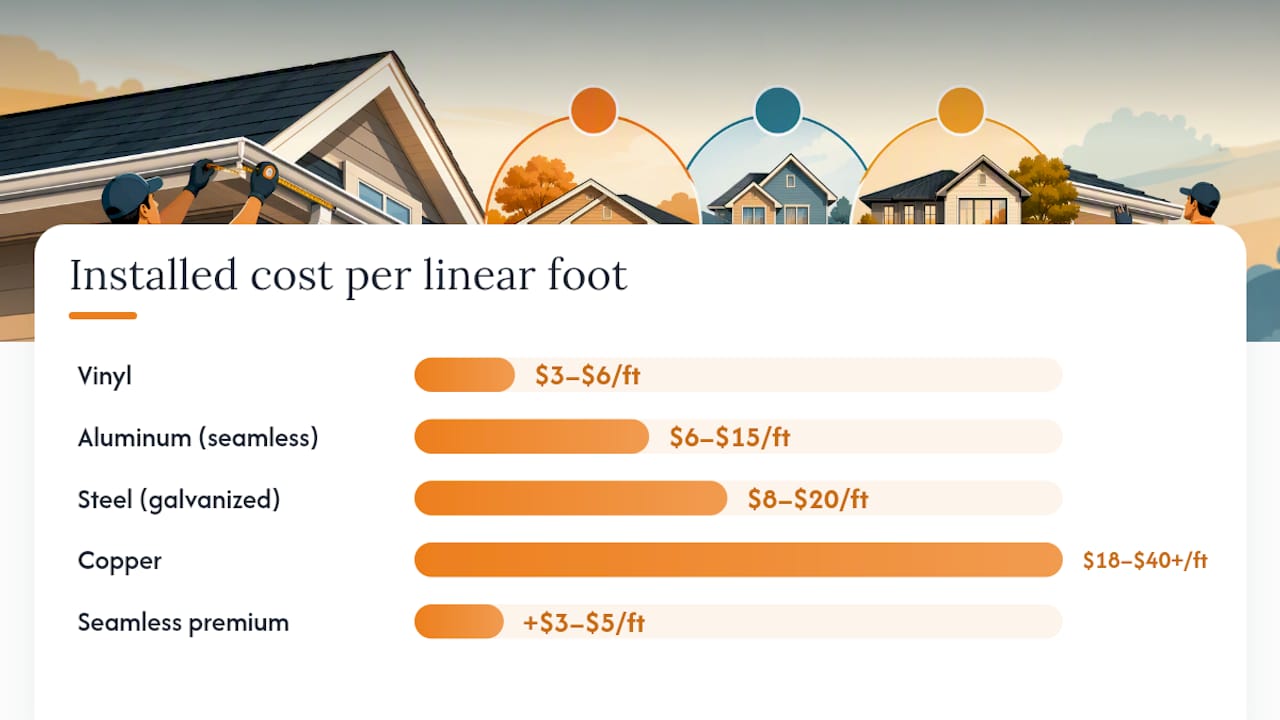
Seamless vs. sectional matters as much as the metal itself. Sectional gutters come in pre-cut lengths joined with connectors, which means more seams, more potential leak points, and a lower upfront cost, often $3 to $5 per linear foot cheaper than seamless. Seamless gutters get custom-cut on-site to match your roofline exactly, cutting seams down to the corners and downspout drops. Fewer seams means fewer leaks over the system’s life, which is why most professional installers push seamless as the standard now, even though homeowner guides note sectional systems still have a place for tight budgets or DIY projects.
If your home has a straightforward roofline and you’re not fighting brutal winters, aluminum seamless is the sensible default. Save the upgrade budget for steel or copper only if your climate or architecture genuinely calls for it.
Why Do Gutter Quotes Vary So Much Between Contractors?
Two contractors can walk the same house and hand you numbers $1,000 apart, and it’s rarely because one is trying to rip you off. Several concrete factors drive that spread.
Linear footage and roofline shape. A simple rectangular ranch needs far less material and labor than a home with multiple gables, dormers, or wings. Every inside and outside corner adds cutting time and connector pieces.
Roof pitch. Steeper roofs are more dangerous and slower to work on, which raises labor cost. Crews need more safety equipment and move more cautiously on a 10:12 pitch than a 4:12 pitch.
Number of stories. A two-story or three-story home requires ladder work, scaffolding, or lift rental that a single-story ranch never needs. This alone can add several hundred dollars to a bid.
Fascia condition. If the wood behind your existing gutters has rotted from years of overflow or clogging, that repair gets tacked onto the estimate, sometimes adding $10 to $20 per linear foot for fascia replacement alone.
Regional labor rates. Construction labor costs vary significantly by metro area. The Bureau of Labor Statistics’ occupational wage data shows meaningful gaps in construction trade wages between regions, and gutter installers price accordingly. A crew in a high cost-of-living metro will simply charge more per hour than one in a rural market, even for identical work.
Pro Tip: Ask every contractor to itemize labor and material separately. If one bid is dramatically lower, check whether they’ve quoted sectional gutters instead of seamless, or skipped fascia inspection entirely.
Permits, disposal fees, and hidden repairs round out the variance. Most municipalities don’t require a permit for straightforward gutter replacement, but some do for major structural attachment changes, so it’s worth a quick call to your local building department before assuming it’s a non-issue.
How Do You Measure Your Roofline for a Gutter Estimate?
Getting your own rough measurement before a contractor shows up lets you sanity-check their bid instead of taking their number on faith.
- Walk the perimeter of your roofline where gutters will hang, measuring each straight run with a tape measure or a laser measuring tool. Add up every section along the eaves, not the total perimeter of the house footprint.
- Count your corners. Each inside or outside corner needs a miter piece, which adds a small amount to material cost but doesn’t add much linear footage.
- Count downspouts you’ll need. A general rule is one downspout per 30 to 40 feet of gutter run, more in areas with heavy rainfall.
- Add a 5 to 10 percent waste allowance for cuts, mistakes, and end caps.
- Check your numbers against a gutter sizing calculator that factors in roof drainage area, which also tells you whether you need standard 5-inch gutters or oversized 6-inch gutters for a steep or large roof.
Real numbers make this concrete. A 40-foot run, common for a single-story addition or garage, needs one downspout and roughly 42 to 44 linear feet with waste factored in. A typical 2,000 square foot home usually has 150 to 180 feet of actual roofline, meaning a 100-foot gutter order would only cover a smaller home or a partial replacement, not a full house. Always measure the whole roofline before assuming a round number like 100 feet applies to your house.
What Add-Ons and Maintenance Costs Should You Budget For?
The base installation number is rarely the whole story. Several common add-ons show up on most real invoices.
- Gutter guards: $7 to $15 per linear foot on top of installation, but they cut cleaning frequency dramatically and can extend gutter lifespan by preventing debris buildup that leads to rust and sagging.
- Oversized downspouts: Upgrading from 2x3 inch to 3x4 inch downspouts adds modest cost but moves significantly more water during heavy storms.
- Fascia and soffit repair: $10 to $35 per linear foot depending on damage extent and material.
- Flashing replacement: Often bundled in if your roofer flags corroded or missing flashing during teardown.
- Painting or color-matching: Aluminum gutters come pre-finished, but steel systems sometimes need field painting to match trim.
Ongoing maintenance matters just as much as installation cost. Clean gutters twice a year, spring and fall, more often if you’re under heavy tree cover. Professional cleaning typically runs $100 to $250 per visit depending on home size and accessibility. Skipping this is exactly the kind of shortcut that undermines the moisture control that proper drainage systems are designed to provide, since clogged gutters send water straight down your foundation instead of away from it.
Pro Tip: Gutter guards pay for themselves fastest on homes surrounded by mature trees. If your roofline is mostly clear of overhanging branches, basic cleaning twice a year is often cheaper over ten years than a guard system.
How to Get Accurate Quotes and Compare Bids
A gutter installation estimate is only useful if it’s specific enough to compare against another one line by line. Before you accept any bid, run it through this checklist.
- Exact linear footage measured, not estimated from satellite photos or a drive-by look.
- Material and gauge specified (for example, 0.027-inch aluminum versus a thinner, cheaper gauge).
- Seamless or sectional clearly stated, since the price difference should match the system type.
- What’s included: downspout count, gutter guards if discussed, disposal of old gutters, and cleanup.
- Permit responsibility: who pulls it, if one is needed, and who pays the fee.
- Warranty terms: material warranty from the manufacturer versus workmanship warranty from the installer, which are two different things.
- Timeline: start date and expected completion, usually one day for most homes.
Red flags worth walking away from include a contractor who won’t provide proof of licensing and liability insurance, one who demands full payment upfront, or a bid dramatically lower than every other quote with no explanation for the gap. Verify licensing through your state’s contractor licensing board before signing anything.
| What to check | Why it matters |
|---|---|
| Written linear footage | Confirms you’re comparing the same job size across bids |
| Material gauge and brand | Cheaper gauge aluminum dents and sags faster |
| Insurance certificate | Protects you if a worker is injured on your property |
| Line-item pricing | Reveals padding or missing scope before work starts |
This is exactly the kind of comparison lead-matching platforms are built to speed up. Instead of calling five companies individually and hoping they all measure the same way, you post your project once and get matched with local, verified installers who can quote against the same scope.
Real Budget Examples: Small, Medium, and Large Projects
Numbers land better with real scenarios attached to them.
- 40-foot run (garage or small addition): Seamless aluminum at $10/ft installed = $400, plus one downspout (~$75) and minor fascia touch-up (~$100). Total: roughly $500 to $600.
- 100 feet on a smaller ranch home: Seamless aluminum baseline at $8 to $12/ft = $800 to $1,200, plus two downspouts (~$150) and basic gutter guards on the front elevation (~$400). Total: roughly $1,350 to $1,750.
- Large, complex roofline with steel and multiple stories: 220 linear feet at $14/ft = $3,080, plus scaffolding access fee (~$300), four downspouts (~$300), and fascia repair on one section (~$400). Total: roughly $4,000 to $4,500.
These aren’t quotes, they’re planning anchors. Your actual bid will move based on your specific roofline, regional labor rates, and whatever your contractor finds once the old gutters come down.
How Long Does Gutter Installation Actually Take?
Most straightforward residential gutter installations take a single day, sometimes less for smaller homes. The full timeline from first contact to finished job usually breaks into three phases.
Assessment and quoting takes the longest stretch, typically a few days to two weeks depending on contractor availability. This includes the site visit, measurement, and written estimate. If you’re comparing multiple bids, budget extra time here since you’ll want at least two or three contractors out to look at the house before committing.
Material ordering for seamless systems is fast because the gutter itself gets fabricated on-site the day of installation using a portable forming machine. Sectional systems or specialty materials like copper may need a lead time of one to three weeks for the material to arrive.
Installation day itself runs anywhere from a few hours for a small ranch to a full day or slightly more for a large, multi-story home with a complex roofline. Crews typically remove old gutters, inspect and repair fascia as needed, hang new gutters and downspouts, and clean up debris in one visit. Weather is the main wildcard. Rain or high wind can push installation back a day, so scheduling in dry seasons tends to go smoother than trying to squeeze work in during a rainy stretch.
Rushing this process is rarely worth it. A contractor who can start tomorrow with no site visit is skipping the measurement step that determines whether your quote is even accurate.
Do Gutter Prices Vary by Region or Climate?
Yes, and the variation comes from two separate forces: labor markets and weather-driven material needs.
Labor costs differ by metro area, and gutter installation is no exception. Areas with a higher cost of living and tighter skilled-labor supply tend to see higher per-foot installed pricing, consistent with the regional wage patterns the Bureau of Labor Statistics tracks across construction trades. A homeowner in a major coastal metro should expect quotes on the higher end of national ranges, while rural and lower cost-of-living regions often land closer to the low end.
Climate changes the equation too, but through material choice rather than raw labor cost. Homes in the Snow Belt, think the Midwest and Northeast, often need steel gutters or heavier-gauge aluminum to handle ice dams and snow load, which pushes the per-foot price above what a mild-climate homeowner would pay for standard aluminum. Coastal and humid Southeast homes deal with faster corrosion, which sometimes justifies the upgrade to aluminum over cheaper materials even on a tight budget. Wildfire-prone regions in parts of the West increasingly see homeowners choosing metal gutters and guards partly for ember resistance, adding to material cost but reducing risk.
Rainfall intensity matters more than most homeowners realize. Regions with heavy seasonal downpours often need 6-inch gutters and oversized downspouts instead of standard 5-inch systems, which adds to both material and labor cost but prevents overflow during storms.
What This Guide Gets Right That Most Estimators Miss
Most online gutter cost calculators spit out a single number and call it a day. That number is almost always wrong for your specific house, not because the math is bad, but because it can’t account for your roofline’s actual complexity, your region’s labor rates, or the fascia rot your contractor won’t find until the old gutters come down.
The homeowners who end up happiest with their gutter project aren’t the ones who found the lowest bid. They’re the ones who measured their own roofline first, understood what a fair per-foot rate looks like in their region, and asked pointed questions when a quote didn’t add up. That’s the gap lead-matching services aim to close, connecting homeowners with vetted local professionals so comparing real bids takes days, not weeks.
— Paulo
Get Matched With Local Gutter Installers Through Pnvleads
Such services get you multiple local, comparable gutter quotes without the runaround of calling five companies and repeating your roofline measurements five times. You post your project once, describing your home size, current gutter condition, and material preference if you have one, and get matched with local professionals who work in your area and specialize in the job you need.

Better project details lead to better matches. Mention your home’s story count, roof pitch if you know it, and whether you’re dealing with existing damage like rotten fascia, since that shapes which pros get matched to your listing. Once you’re matched, you’ll get contact details for local installers and can discuss project specifics directly, comparing at least three bids before choosing anyone is the smartest move you can make here, using the checklist above to keep the comparison honest. Post your project on Pnvleads and start collecting real, local quotes today.
Sources
- Roof and Gutter Replacement Cost: Price Ranges for U.S. Projects 2026 – Current Cost
- Cost of a New Roof and Gutters: Complete Guide for Homeowners – New England Metal Roof
- Moisture control guidance — EPA
- Occupational Employment Statistics — BLS
FAQ
How much are gutters for a 2,000 square foot house?
A 2,000 square foot home typically has 150 to 180 linear feet of roofline needing gutters, which runs roughly $1,200 to $2,500 installed with seamless aluminum at standard per-foot rates. The exact number depends on how many stories the home has and how complex the roofline is.
How much does it cost to install 40 feet of gutter?
A 40-foot gutter run typically costs $400 to $600 installed with seamless aluminum, including one downspout and standard hardware. Steel or copper would push that total noticeably higher per linear foot.
How much does Lowe’s charge to install gutters?
Big-box retailers like Lowe’s generally don’t employ their own installers directly. They connect customers with contracted installation partners, and pricing follows similar per-linear-foot ranges to independent local contractors, typically in the $6 to $15 per foot range for seamless aluminum. Getting a direct quote from the retailer or comparing it against local pros through a service like Pnvleads is the only way to know if you’re getting a competitive rate.
How much is 100 feet of gutter?
A 100-foot gutter run costs roughly $800 to $1,500 installed with seamless aluminum, before add-ons like downspouts or gutter guards. Material upgrades to steel or copper would raise that total, sometimes by $1,000 or more.
What’s the difference between gutter replacement cost and installation cost?
Gutter replacement typically includes removing and disposing of the old system, which adds a modest cost on top of standard installation, sometimes $1 to $3 per linear foot for teardown and haul-away. New construction installation skips that step, making it slightly cheaper on a per-foot basis.